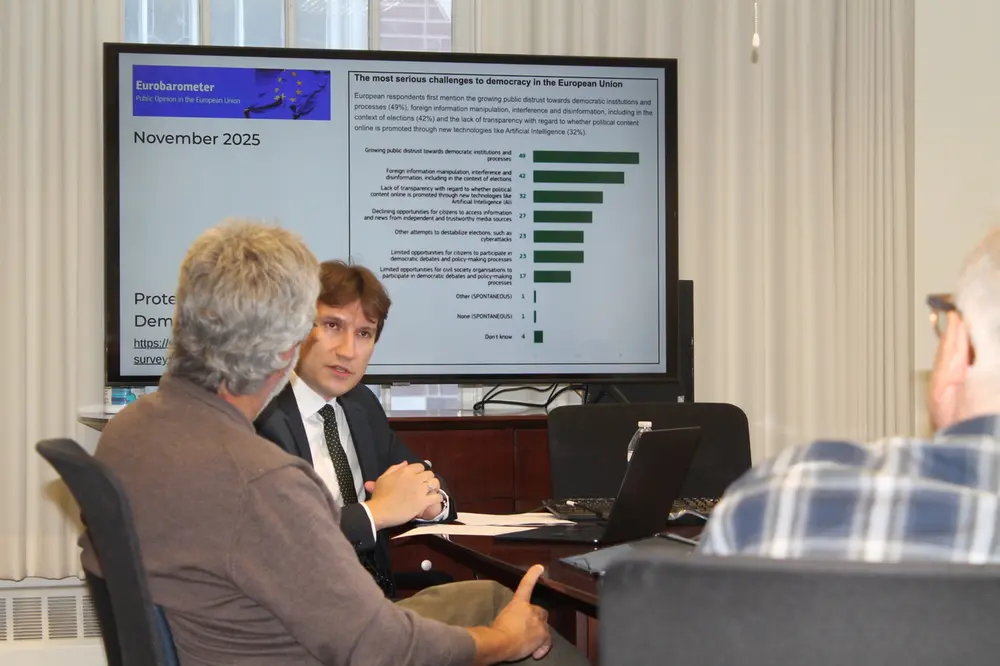
On October 5th, 2026, the EUC center hosted a talk by Maxim Krupskiy, who is an affiliate of REEEC, on “Ensuring Non-Interference, Maintaining Resilient Democracy: Contemporary Challenges in Legislation on Countering Covert Foreign Influence”. Krupskiy, who was an attorney in Russia for more than 12 years, where he defended human rights, has been part of the Illinois Scholars at Risk Program since 2024. His talk examined concerns around foreign interference in democratic countries, particularly focused on the Venice Commission’s legislation on the subject, and how its proposed solutions to this interference by Russia in the European Union may be flawed.
More specifically, Krupskiy argued that the laws proposed in the Venice Commission are too vague, and may undermine trust and the rights of freedom of expression and association, as well as failing to catch the specific threats the writers are concerned about. Attempting to target all foreign interference will also target democratic allies, such as Canada and the US, and will impact groups such as think tanks, as well as political parties and lobbyists with actual political influence. Additionally, labeling something as a “foreign agent”, does not necessarily prevent them from continuing to share their views or continuing their foreign interference. Krupskiy suggests that, rather than focusing on one broad law, which could theoretically target all threats but might be misapplied or misinterpreted, that more diverse laws against more specific threats would be less vague and more effective.