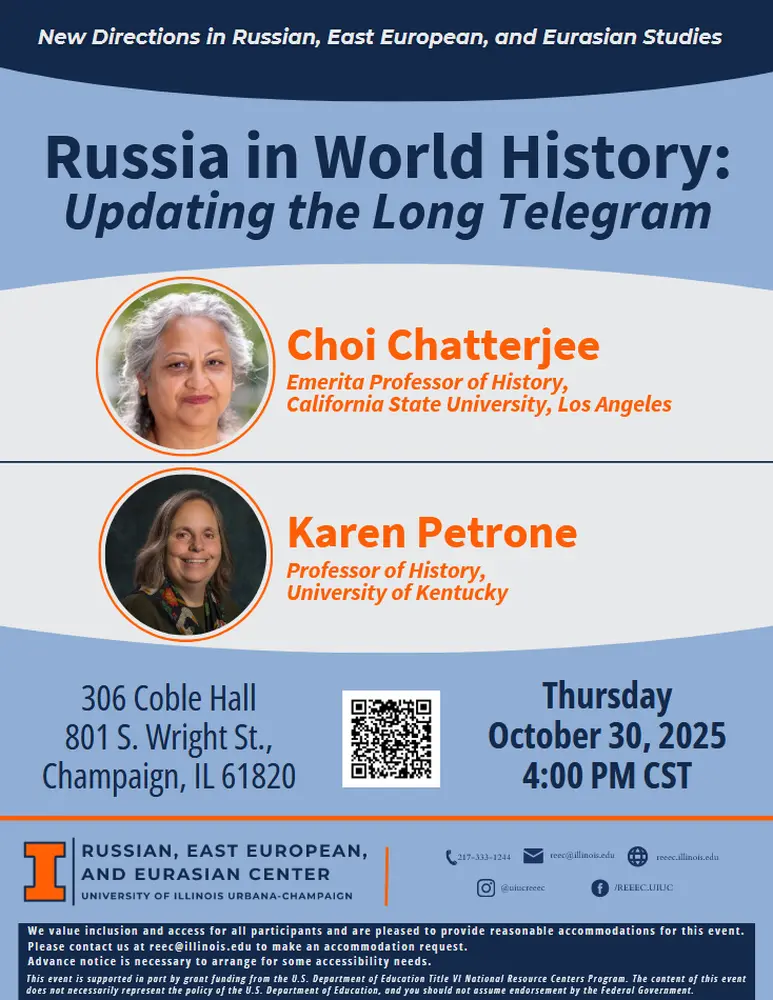
On October 30, 2025, the Russian, East European, and Eurasian Center hosted a New Directions Lecture titled “Russia in World History: Updating the Long Telegram,” featuring historians Choi Chatterjee and Karen Petrone.
Chatterjee is Professor Emerita of History at California State University, Los Angeles, and co-director of the Urban Ecology Center. She is the author of Russia in World History: A Transnational Approach (2022). Petrone is Professor of History at the University of Kentucky and co-director of the UK-JHF Holocaust Education Initiative. She is the author of Life Has Become More Joyous, Comrades: Celebrations in the Time of Stalin (2000) and The Great War in Russian Memory (2011).
The speakers explored the historical and contemporary influences shaping Russia’s network of international alliances, particularly its relationships with countries in the Global South. Their presentation examined how Russia promotes a multipolar world order as an alternative to Western capitalism, liberal democracy, and globalization.
Felipe De Los Santos, an M.A. student in Russian, East European, and Eurasian Studies, described the lecture as deeply informative.
“Choi Chatterjee and Karen Petrone gave a deeply informative talk on Russia’s role in the world,” De Los Santos said. “They highlighted how Russia continues to maintain multiple formal and informal alliances and how these relationships provide the leverage it needs to sustain itself amid its ongoing invasion of Ukraine.”
Felipe also noted the speakers’ use of Victory Day parade attendance as a way to assess Russia’s international relationships.
“By examining which states attended the Victory Day parade and which representatives they sent, the speakers offered new insights into how closely connected Russia is to these countries,” he said. “Most importantly, they highlighted Russia’s continued and growing influence in the Global South, where it is often seen as an attractive partner and an alternative to the United States and the current global system of governance.”
The lecture demonstrated the importance of understanding Russia’s international alliances for American foreign policy, academic scholarship, and university curricula.